Force 1
Demand has never been higher
Post-pandemic mental health diagnoses increased 25% from 2020–2023 (APA). First-time therapy seekers hit all-time highs. The consumer is primed and actively searching.

Learn why mental fitness and longevity is the next boom in America.
Two parallel paths. The map shows what's left. The intro call books direct with our exec team.
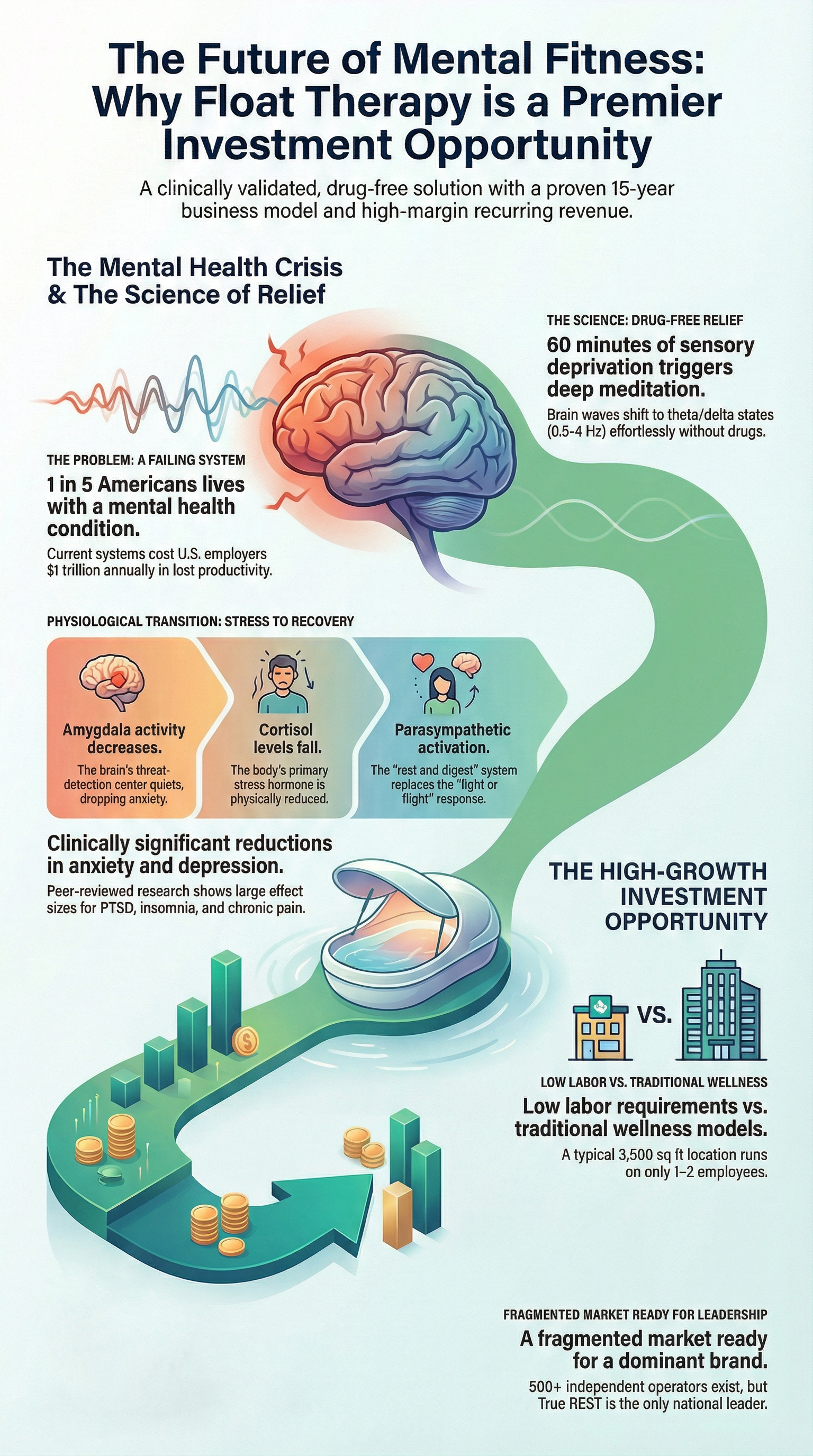
1 in 5 Americans lives with a mental health condition, yet outcomes have not improved proportionally despite record spending.
Over 37 million Americans are prescribed antidepressants. More than half discontinue treatment within three months due to side effects, cost, or lack of efficacy.
Anxiety disorders affect over 40 million U.S. adults — the most common mental health condition in the country.
Employers lose over $1 trillion annually to productivity losses associated with mental health conditions.
Total U.S. mental health spending now exceeds $280 billion per year — without commensurate improvements in outcomes.
The system isn't broken because people aren't trying. It's broken because the tools haven't caught up to the problem.
"Participants showed significant reductions in anxiety and depression following a single float session. The effect sizes were large and clinically meaningful.
Float therapy has been studied for decades, beginning with federally funded research at the National Institute of Mental Health.
Modern clinical trials show floatation REST produces some of the largest effect sizes ever recorded in single-session anxiety interventions.
In practical terms, floating delivers in one hour what many people spend years attempting to achieve through meditation — with documented, peer-reviewed neuroscience.
Post-pandemic mental health diagnoses increased 25% from 2020–2023 (APA). First-time therapy seekers hit all-time highs. The consumer is primed and actively searching.
The global wellness market is valued at $5.6T. Mental wellness is the fastest-growing segment, driven by prevention-focused consumers.
500+ independent float centers exist today — mostly undercapitalized with no national brand infrastructure. That gap is the opportunity.
"Mental fitness" has replaced "mental health." Consumers respond to performance, optimization, and results — not spa language.
The yoga industry looked exactly like this in 2005 — fragmented, clinically credible, searching for a scalable system. The investors who recognized that window didn't wait for consensus. They built category leaders.
Two parallel paths. The map shows what's left. The intro call books direct with our exec team.
Most wellness businesses sell a luxury. Float therapy sells a measurable outcome that members return to on a weekly basis. The membership model, the small footprint, and the low labor requirement create unit economics that are difficult to find in the wellness franchise space.
The model is setup. They have paved the road. We just need to get in the car and go.
Lease signed. Build-out begins. You're executing a system tested in 22 states.
Training underway. Pre-opening memberships sold.
Doors open. First members walk in. First recurring revenue hits.
Membership base established. Marketing systems running. You're no longer an investor — you're an operator with cash flow.
"Most franchisees close their first 50–100 members within the first 30 days."
You now have what most investors spend months trying to find: documented clinical outcomes, massive unmet demand, fragmented competition, and 15 years of franchise proof.